Tobruk and the Black Sea: Russian Military Transfers and Probable Experimental Tests
- Feb 6
- 3 min read

Analytical Summary
Satellite imagery and AIS tracking suggest a probable consolidation of Russian military presence in eastern Libya, with Tobruk emerging as a key logistical hub. The Russian cargo ship Mys Zhelaniya, subject to international sanctions, was observed offloading heavy equipment in January 2026. Subsequently, in the Black Sea, the vessel’s behavior – prolonged loitering and low-speed maneuvers – is consistent with probable experimental testing activity, potentially involving Electronic Warfare (EW) systems or underwater unmanned vehicles (UUVs), observable and monitorable via open-source intelligence (OSINT).
This sequence is consistent with Russia’s broader strategy of power projection in the Mediterranean and Africa, supported by the Africa Corps, the formal successor to former Wagner Group operations.
1. Context
It is highly probable that the arrival of Mys Zhelaniya in Tobruk around 20 January 2026 reflects a deliberate Russian effort to strengthen logistical and military posture. The vessel, a 17,000 DWT cargo ship, departed from Baltiysk (Kaliningrad) and traveled in convoy with the Sparta IV (also sanctioned), escorted by the Severomorsk destroyer (Udaloy-class). Tobruk is controlled by Khalifa Haftar’s forces, supported by Moscow.
The use of a high-level naval escort indicates that the cargo was likely strategic, aimed at minimizing exposure to interception or intelligence gathering by adversaries.
2. Analysis
2.1 Transit and Maritime Security
The convoy initially declared Port Said as its destination, plausibly to mask the actual route to Tobruk. This behavior aligns with patterns observed in sensitive military transport operations.
2.2 Activity at Tobruk

Optical satellite imagery from 16–17 January shows Mys Zhelaniya moored and offloading, with indications of:
Heavy logistical vehicles (trailers and transporters ready for ground deployment);
Specialized assets compatible with S-300/S-400 radar trucks;
Heavy weaponry, including T-55, T-64, T-72A main battle tanks and artillery pieces (howitzers).
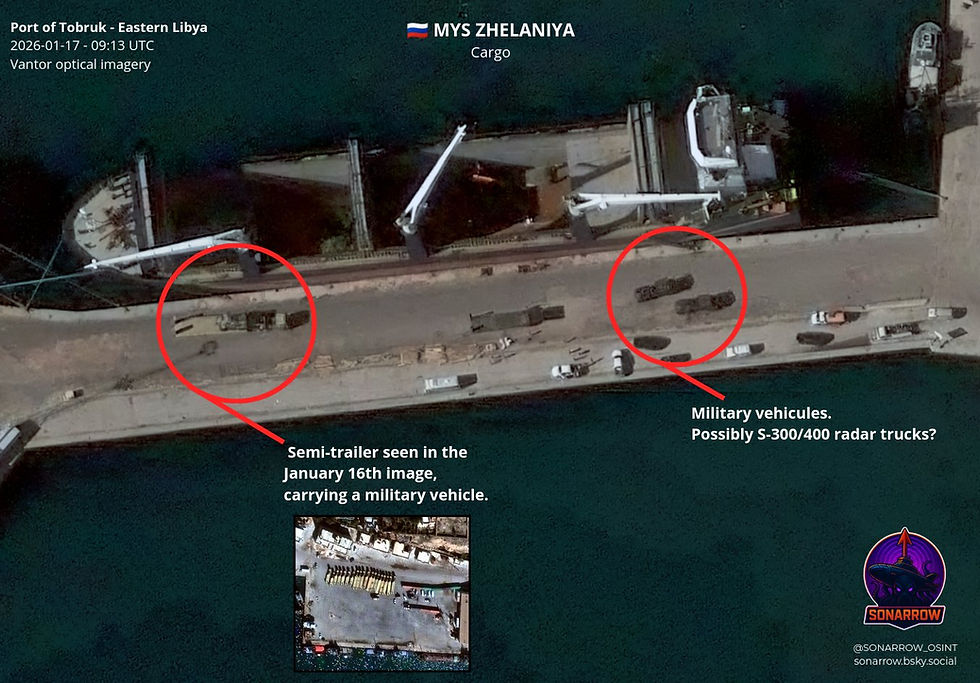
It is plausible that Tobruk is evolving into a permanent logistical hub, with capacity to support both ground operations and aerial surveillance.
2.3 Ground Consolidation
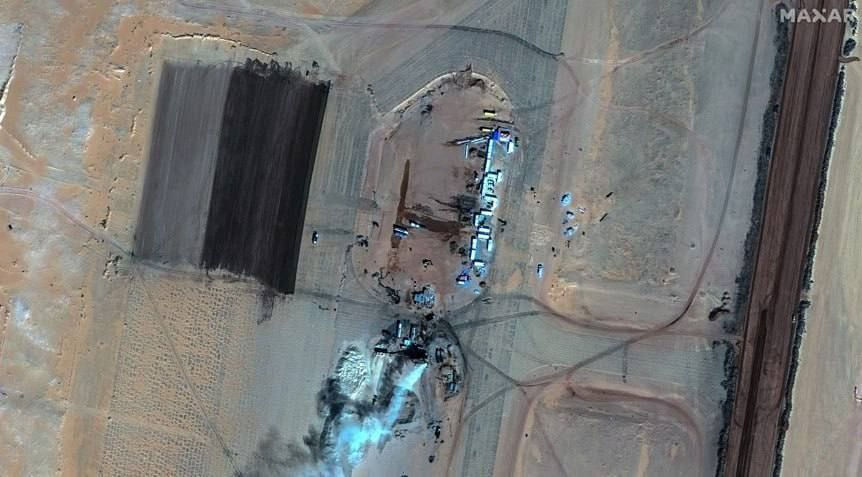
OSINT data suggests Russia is reactivating inland air and logistics bases, including Matan al-Sarra near the Chad border, creating a deep operational supply network to support Africa Corp
s operations and regional power projection in the Sahel.

2.4 Black Sea Activity: Probable Experimental Testing
From 28 January, the ship loitered approximately 90 nautical miles south of Sevastopol at speeds between 2–13 knots. This pattern is likely indicative of experimental testing, potentially involving:
Electronic Warfare (EW) system calibration or signals intelligence (SIGINT) collection;
Underwater unmanned vehicle (UUV) or sensor trials;
Low-visibility intelligence, surveillance, and reconnaissance (ISR) missions.
These operations, while high-value, are observable via OSINT, allowing analysts to track emerging Russian capabilities without classified sources.

3. Operational and Strategic Implications
Paramilitary reorganization: Tobruk serves as a logistical node for the Africa Corps, formalizing the transition from Wagner Group operations.
Infrastructure expansion: Reactivated inland bases, such as Matan al-Sarra, enable deep logistics and operational reach in the Sahel.
Airspace control: Deployment of advanced radar systems (S-300/S-400) likely enhances regional aerial surveillance and control.
Permanent naval presence: Frequent activity in the Mediterranean and Black Sea indicates a Russian strategy to stabilize naval presence, complementing Tartus with new African bases.
Probable monitorable experimental tests: Black Sea operations suggest dual-use testing (EW/UUV), sufficiently visible for OSINT monitoring, offering insights into emerging Russian capabilities.
4. Intelligence Limitations
Radar system identification remains probable but not confirmed;
Full cargo composition inside the vessel is not accessible;
Internal logistics distribution between Tobruk, Matan al-Sarra, and other bases remains partially obscured;
Exact purpose of Black Sea tests cannot be confirmed without classified SIGINT or high-resolution military satellite data.
Conclusions
The Mys Zhelaniya operation demonstrates enhanced Russian logistical and strategic capabilities in North Africa, combined with experimental Black Sea operations that suggest innovation in EW and underwater capabilities. Tobruk is emerging as a critical hub for Africa Corps, while the integrated Mediterranean-North Africa network strengthens Russia’s ability to support regional operations with advanced assets.


Comments